What is the History of Big Fairground Rides?
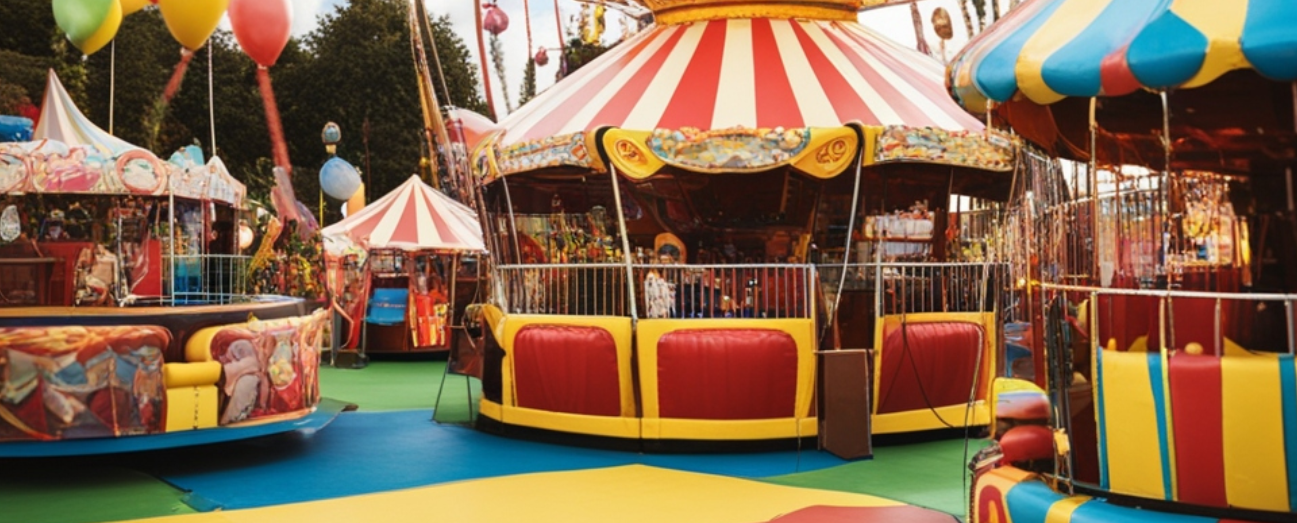
The history of big funfair rides stretches back over centuries, evolving from simple manually or horse-powered attractions to the spectacular, technologically advanced fairground rides we see today. This journey from the rudimentary to the revolutionary reflects broader changes in technology, society, and entertainment preferences.
The genesis of funfair rides can be traced back to the 17th century when annual fairs featured small rides powered by manpower or horses. An example from around 1860, Twigdon’s Riding Machine, showcased riders on wooden horses on a ring-shaped platform, reminiscent of the modern playpark merry-go-round ride.
The 1860s marked a pivotal era with the introduction of steam power to funfair rides. Frederick Savage, a renowned fairground engineer from King’s Lynn, Norfolk, was at the forefront of this revolution. By 1870, Savage had produced the Velocipede, a steam-powered fairground ride that featured bicycles. However, his most significant contribution would be the development of steam-powered carousels, or 'gallopers', which would become emblematic of funfairs worldwide.
Following steam, the internal combustion engine and later electricity further transformed fairgrounds with larger, faster, and brilliantly illuminated rides. This technological leap necessitated substantial investment, pushing showmen towards larger fairs and contributing to the decline of smaller, village fairs. It also paved the way for the first purpose-built, permanent amusement sites.
The evolution of big funfair rides from their humble beginnings to the complex engineering marvels of today is a testament to human creativity and the desire for entertainment, and we can't wait to see what the future holds!
From steam-powered gallopers to high-flying bungee trampolines, the history of the biggest funfair rides intertwined with the history of fairground itself. They reflect the technological advancements of their times and the ever-changing tastes of audiences seeking fun and excitement.
At We Are Tricycle, we celebrate this rich heritage by offering a wide range of funfair rides, including classics like Helter Skelters and giant slides, as well as thrill and white knuckle rides that continue to push the boundaries of funfair entertainment.
To learn more about the fascinating history of big funfair rides and to see our full collection of modern attractions, check out our funfair history guides!
Big Funfair Rides Changed What a Fairground Could Look Like
As fairground engineering developed, rides could become more substantial structures and create movement at greater height or over a larger footprint. That changed more than the passenger experience. Large attractions became prominent visual features capable of defining the appearance of an entire fairground.
The broader development of mechanical entertainment is explored in What Is the History of the Funfair?, while big funfair rides shows the variety of substantial attractions available today.
Height Became One Way to Create a Major Attraction
Some large rides use height as a central part of their appeal. Ferris wheels provide the clearest example because their scale can make them visible well beyond the immediate ride area, while other tall attractions combine height with much faster movement.
What Is the History of the Ferris Wheel? follows the development of one of the best-known large ride types. How Much Space Is Needed for Ferris Wheel Hire? moves from history into the practical considerations involved in providing one at an event.
Other Big Rides Developed Through Movement Rather Than Height
A substantial fairground attraction does not necessarily need to dominate the skyline. Large rotating platforms, swinging structures and complex moving ride systems can create their impact closer to ground level.
The histories of the Waltzers, the Booster and the Miami show how different mechanical principles have produced very different fairground experiences.
Large Rides Have to Be Designed with Travel in Mind
A permanent amusement park can build an attraction for one location. A travelling fairground presents a different engineering problem because substantial equipment may need to move repeatedly between event sites.
How Are Funfair Rides Transported? looks more closely at this side of travelling entertainment, while How to Safely Load Funfair Rides covers an important part of the movement process.
A Big Ride Changes the Planning of the Site Around It
Major attractions have to be considered as part of the overall event layout. Equipment footprint is only one factor. Organisers and operators can also need to consider suitable access, surrounding space, visitor movement, queues and the relationship between neighbouring attractions.
How to Place Funfair Rides Around the Site explores this wider planning question, while How to Manage Queues at Funfairs looks specifically at managing waiting visitors.
Engineering Progress Goes Hand in Hand with Inspection
The increasing sophistication of amusement rides has also made engineering, inspection and maintenance an important part of understanding the modern fairground. Large structures may incorporate numerous mechanical, structural, electrical and control components, with requirements determined by the particular equipment.
How Funfair Rides Are Tested for Safety introduces the testing process, Funfair Ride Periodic Maintenance looks at continuing maintenance and Non-destructive Testing of Funfair Rides explores a more specialised inspection subject.
Big Rides Now Occupy Several Different Parts of the Fairground
"Big funfair ride" is therefore best understood as a broad description rather than one particular type of attraction. Modern events can combine towering observation rides, spinning attractions, roller coasters and high-intensity machinery, each creating scale in a different way.
Compare Ferris wheels, roller coasters and thrill & white knuckle funfair rides for three different branches of large-scale fairground entertainment. How to Choose the Right Funfair Rides & Games can then help connect attraction choice with the practical requirements of an event.
Our Guides contain further articles about fairground history, engineering, safety and planning. You can also browse fairground rides and all products, or contact us to discuss suitable rides for an event.