How to Dismantle and Assemble Funfair Rides
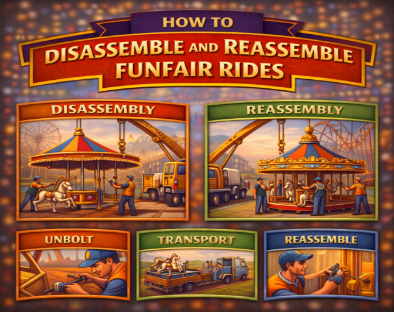
We Are Tricycle know how important it is to do things by the book when it comes to expensive and heavy equipment such as funfair rides. A wrong move here, or a little error there could have disastrous consequences and might end up in a broken or malfunctioning piece of expensive equipment. Given how important this is, we have put together a little guide on the best way to dismantle and transport funfair rides and fairground games. Again, this is super important and integral to making sure all funfair rides, fairground equipment and carnival items are available to make sure customers' parties are as special as they want!
Site location

The first thing to do is make contact with the site operator or organiser. This is to make sure any issues with the location of the party are discussed. This means we can avoid any stuck wheels, or sinking pieces of machinery in boggy grass. The organiser will know exactly what type of thing goes where, and can tell you which areas to avoid. Making contact with locals is super important because we don't have an extensive amount of local knowledge.
It's also really important to make sure structures or surfaces can safely beat the load of the equipment, whatever this might be. This is again where local knowledge will be integral. The site operator can give you specific guidance on weight bearing and appropriate surfaces. Please also take into account manufacturer guidance when considering what goes where.
When moving items and equipment please also follow similar guidance. Make sure the vehicle used to move heavy machinery is properly equipped. There is no use travelling with heavy funfair items if your vehicle is going to break down and no one can use the items! All items must be securely fastened and tightened to reduce any risk of injury to passers by or damaging the equipment itself. This should go without saying, safety is the priority so make sure there is no risk of any sort of personal injury due to ill fitting or poorly secured equipment.
Route
Please make sure the route you've chosen is appropriate for the vehicle and the load. Again, we don't want to end up sinking in a boggy ditch for the sake of getting somewhere ten minutes quicker. Make sure to plot the route correctly. Local knowledge will again be really useful here.
Erecting Funfair Rides
When erecting items and equipment, care must be taken to assemble things properly in the right way. This means no rushing, no throwing and no forcing things where they should not be. If things don't fit, they don't fit. Always consult superiors and manuals to make sure everything is going in its right place. R clips should be used where appropriate. All equipment should be cleaned and maintained to the highest level. This will reduce wear and tear and also mean things slot into place properly, without using force.
Using the above guide and combining it with your own knowledge, you should be able to transport everything safely! Make sure you check out our other funfair ride health and safety guides for additional information.

Assembly and Dismantling Are Part of Safe Ride Operation
A mobile funfair ride is designed to travel, be installed, operate for an event and then be taken apart for transport again. That repeated cycle means assembly and dismantling are not just logistical tasks. They are part of the safety-critical life of the attraction.
If you are interested in how this process fits into the wider operation of fairground rides, it is useful to read it alongside How Are Funfair Rides Transported?, Funfair Ride Set Up and Tear Down Procedures and Daily Safety Checks for Funfair Rides. Together, these guides explain how mobile amusement equipment moves from transport to operation and back again.
Preparation Starts Before the Ride Reaches the Site
Successful assembly depends on planning the delivery route, access, unloading area and final ride position before the equipment arrives. Large attractions may require substantial space and carefully managed vehicle movements, while smaller rides can still need clear access and suitable ground conditions.
Our How to Place Funfair Rides Around the Site guide is useful at this stage because the assembly area, finished ride footprint, queues and surrounding attractions all need to work together. This is particularly important when combining big funfair rides, family funfair attractions and rides and fairground side stalls and games on the same event site.
Different Rides Have Different Assembly Requirements
There is no single assembly method that applies to every attraction. A Giant Ferris Wheel, Modern Dodgems, Traditional Victorian Carousel and Apple Coaster - Family Roller Coaster are very different machines, with different structures, components and operating systems.
That is why ride-specific instructions, competent personnel and appropriate procedures matter. The work involved can include positioning structural sections, securing components, connecting mechanical and electrical systems, fitting restraints or barriers and carrying out checks before the attraction is made available to passengers.
Checks After Assembly Matter Just as Much as the Build
Completing the physical build does not mean a ride is automatically ready to open. Appropriate inspection and operational checks help confirm that the attraction has been assembled correctly and is functioning as intended.
For more on the inspection side, see How Funfair Rides are Tested for Safety, Funfair Testing FAQs and What is the ADIPS Scheme?. Ongoing condition and maintenance are covered separately in Funfair Ride Periodic Maintenance.
Electrical Connections Need Proper Attention
Many amusement rides rely on electrical systems for drive motors, controls, lighting and safety functions. Connections made during setup therefore need to be treated as part of the wider installation process rather than as an afterthought.
Our Fairground Electrical Safety Regulations page provides more information about this area. Event organisers should also think about how power is routed through the wider site so that cables, generators and other equipment do not create unnecessary problems for guests or staff.
Dismantling Should Be Planned, Not Rushed
Once an event ends, the ride still has to be safely removed from the site. Dismantling can involve reversing many of the installation stages, but it should not be treated as something to hurry through simply because the public has gone home.
Operators may need to secure moving parts, disconnect systems, remove structural sections, prepare components for transport and ensure that the equipment is properly loaded for its next journey. How to Safely Load Funfair Rides provides useful related information about handling equipment around the transport stage.
Site Conditions Can Affect Both Build and Breakdown
Ground conditions, restricted access, poor weather and changing site conditions can all affect assembly and dismantling. A location that is straightforward in dry weather may become more difficult after sustained rain, while high winds may change what work can safely be carried out.
For weather-related planning, see How to Prepare Funfairs for Adverse Weather, How to Keep Funfair Rides Safe in Windy Conditions and Rainy Weather FAQs.
Risk Assessment Should Cover the Installation Phase Too
A funfair risk assessment should consider more than the period when guests are riding. Delivery, unloading, assembly, testing, operation, dismantling and removal can all create different hazards and therefore need appropriate controls.
Our How to Perform a Funfair Ride Risk Assessment guide explains how to think about the wider sequence of an event, while Funfair Emergency Planning and Crisis Management looks at preparing for unexpected situations.
Useful Reading for Event Organisers
If you are booking rides for council and local authority events, company fun days and corporate events, school events or festival hire, understanding the installation process can help with venue planning, access times and communication with suppliers.
For a wider overview of safety responsibilities, see What Are the UK's Safety Standards for Fairgrounds?, Are Fairground Rides Safe? and How We Are Tricycle Protects Your Health And Safety. You can also browse the Guides section for more practical advice about operating and planning funfair events.