How does the Tea Cups funfair ride work?
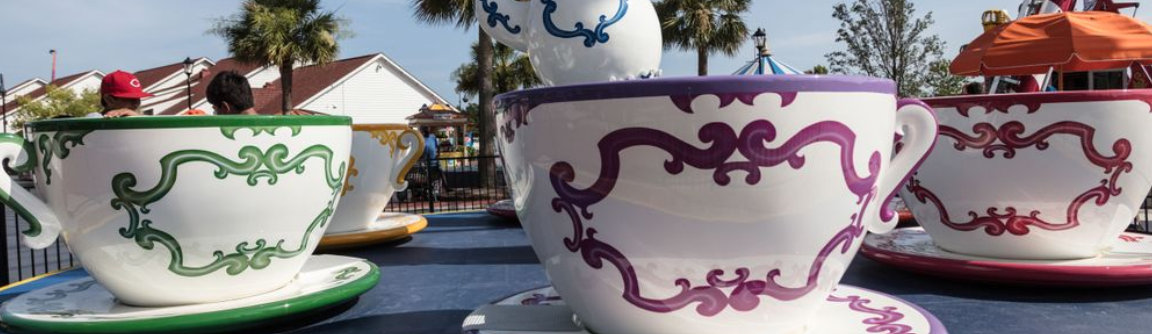
Bring the whirl of the fairground to your event with our enchanting Tea Cups funfair ride. Ideal for team building days, corporate events, and themed events, the Tea Cups ride offers a delightful mix of gentle spins and exciting twirls, making it perfect for all ages.
At the heart of our Tea Cups ride is the principle of centripetal force. This force is crucial as it acts on the riders moving in a circular path, directing them toward the centre of their circular motion.
Each teacup is mounted on a centre bearing beneath it, akin to a car wheel bearing. This setup sits on a rotating platform powered by a motor, which starts off slowly and gains speed. As the funfair ride platform rotates, ride operators can spin each cup individually, adding to the thrill.
As the teacups spin around the central axis, centripetal force comes into play. This force is essential for keeping the riders seated, following the curved path of the ride due to gravitational pull. It’s this scientific principle that ensures safety while adding a fun challenge of balancing the spin speed without becoming dizzy.
Next time you’re enjoying a spin on our Tea Cups ride, pay close attention to how the force impacts your body. The faster the cups spin, the more intense the sensation, demonstrating physics in a fun and interactive way.
Whether you're planning a indoor fairground or an outdoor festival, the Tea Cups ride is a classic attraction that never fails to delight. Not only does it offer a visually captivating spectacle with its colourful design and smooth mechanics, but it also provides a hands-on lesson in physics, making it a fantastic educational tool as well.
Add a spin of joy to your next event with our Tea Cups ride, guaranteed to bring smiles and laughter. Contact us today to arrange your funfair hire!
Tea Cups Combine Two Types of Circular Movement
The distinctive feature of a Tea Cups ride is that passengers do not simply travel around one central point. The cups are carried around the attraction while also being able to rotate, creating overlapping circular movements within the same ride experience.
This makes Tea Cups an interesting comparison with carousels, where passenger positions primarily follow the rotation of the main ride structure.
The Cup Adds Movement Within the Larger Ride Cycle
As the main attraction operates, each passenger cup follows the larger rotating arrangement. The cup's own rotation then adds another layer of movement. The precise mechanical arrangement can vary between individual Tea Cups rides, so not every installation should be assumed to operate identically.
How Are Funfair Rides Powered? provides broader information about the systems used to produce controlled movement on mechanical fairground attractions.
Tea Cups and Waltzers Use Layered Motion in Different Ways
Tea Cups and Waltzers can both involve movement occurring at more than one level, but they are different ride designs. Waltzer cars move around a larger rotating platform while also spinning, creating a distinctive ride experience of their own.
What Is the History of the Waltzers? provides useful background on that attraction, while Modern Waltzers shows how the Waltzer format differs visually from Tea Cups Funfair Ride.
Why Can Spinning Feel Different from Simply Going Around in a Circle?
Layering one rotating movement on top of another can continually change a passenger's direction of travel. This helps explain why Tea Cups can feel quite different from a ride that follows one smooth circular path, even when both attractions remain relatively close to ground level.
People also respond differently to repeated rotation. How to Cope with Motion Sickness at the Fairground provides related guidance for visitors who are sensitive to spinning or changing movement.
Tea Cups Sit Between Traditional and Interactive Ride Experiences
The familiar cup-and-saucer styling gives the attraction a strong traditional fairground appearance, while the rotating passenger vehicles make the experience quite different from simply sitting on a conventional merry-go-round.
traditional & vintage fairground rides & attractions provides other examples of classic fairground formats, while What Is the History of the Carousel? explores the development of one of the best-known circular rides.
Passenger Requirements Come from the Individual Tea Cups Ride
Tea Cups are often associated with family entertainment, but that should not be interpreted as a universal statement about who can use every version of the attraction. Operators need to follow the requirements applying to the particular ride, including its seating and passenger arrangements.
How Tall Do Children Have to Be for Fairground Rides? explains why there is no single height rule covering every attraction, while How to Keep Children Safe at Fairgrounds provides wider family safety guidance.
Mechanical Simplicity Does Not Remove the Need for Ride Checks
Even when a ride appears straightforward from a passenger's perspective, its rotating structures and passenger vehicles form part of an engineered attraction. The wider operational picture includes the appropriate inspection, testing, checks and maintenance for the equipment.
How Funfair Rides Are Tested for Safety, Daily Safety Checks for Funfair Rides and Funfair Ride Periodic Maintenance provide further reading on these different parts of fairground operation.
Compare Tea Cups with Other Circular Fairground Rides
Tea Cups show how changing the way passenger vehicles move can transform a basic circular ride concept. How Does a Ferris Wheel Work? examines rotation on a vertical plane, while What Is the History of Chair-o-Planes? provides background on a circular attraction where passengers travel in suspended seats.
You can also browse family funfair attractions & rides, explore fairground rides, continue through our Guides, or contact us about Tea Cups and other family fairground attractions for your event.