The History of the Buzz Wire Game
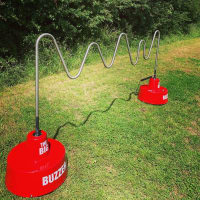
The Buzz Wire, a funfair game synonymous with skill, steadiness, and concentration, has a fascinating origin story rooted in post-war Britain. Invented in 1953 by a talented electrician and skilled electronic engineer, Robert (Bob) Scrimshaw, from Yorkshire, the Buzz Wire, also known as the Beat the Bleep and originally called the "electric loop game", has taken the world by storm in a relatively short timeframe.
Bob Scrimshaw, who served as an electrician for the RAF ground crew during World War II, was renowned for his exceptional skills, particularly in repairing planes under the duress of live combat and bombing raids. His prowess in electronic engineering was well acknowledged among his peers.
The inception of the Buzz Wire can be traced back to a garden party in 1953. Bob's close friend, John Waddington - whose name is behind the Waddingtons company known for producing globally renowned games such as Monopoly, Cluedo, Subbuteo, and Top Trumps - was in need of a unique game for his event and approached Bob for assistance. Rising to the challenge, Bob created the first version of the electric loop game, which he brought along to the party.
This prototype was an instant success at the event, captivating guests with its blend of simplicity and challenge. Recognising the game's potential, John Waddington moved swiftly to patent Bob's design, and Waddingtons began commercially producing the "electric loop game" in the mid-1950s.
The Buzz Wire game, as it came to be known, quickly captured the public's imagination. It challenged players to move a metal loop along a twisted wire without touching it, thus avoiding completing an electrical circuit that would trigger a buzz sound, signalling a fault. Its appeal lay in the immediate feedback of success or failure and the joy of steadily mastering the skill.
From its humble beginnings at a garden party to becoming a staple at funfairs, carnivals, and even science fairs, the Buzz Wire has stood the test of time. It remains a beloved challenge, a testament to Bob Scrimshaw's ingenuity and John Waddington's vision in bringing this captivating game to the masses. If you'd like one of our giant Buzz Wire games at your event, contact us to book your spot!
The Buzz Wire Turns Steady Control into the Main Challenge
The Buzz Wire has a particularly clear objective: guide a handheld loop along a shaped wire without making contact. There are no complicated instructions to learn, but completing the route requires concentration and controlled movement from beginning to end.
That makes it a useful example of how skill games can create entertainment from a very simple physical task.
The Shape of the Wire Creates the Difficulty
A Buzz Wire course can introduce bends, rises, drops and tighter sections that require players to continually adjust the position of the loop. The route itself therefore determines much of the character of the game.
This differs from What Is the History of the Operation Game?, where careful hand control is applied to individual targets rather than one continuous course.
An Error Can Be Understood Instantly
Part of the Buzz Wire's appeal comes from immediate feedback. Contact between the loop and wire can trigger the game's response, so the player and spectators know straight away when control has been lost.
That relationship between an action and an immediate electronic response also connects the game with electronic & digital games, even though the underlying challenge remains physical and easy to understand.
Precision Creates a Different Kind of Pressure from Speed
Many interactive games encourage players to react as quickly as possible. Buzz Wire can create tension differently because moving too aggressively may make precise control more difficult. Players have to balance progress with accuracy rather than simply responding at maximum speed.
What Is the History of Batak? provides a useful contrast because reaction speed is much more central to that style of challenge.
Spectators Can Follow the Attempt Without Playing
The visible route makes a Buzz Wire attempt easy for other guests to follow. People can see how far the player has progressed and watch particularly awkward sections approaching, giving the activity a spectator element despite normally involving one active player at a time.
This helps explain its suitability alongside single player games and queue busters & waiting area games, where straightforward participation can be useful within a wider entertainment programme.
The Basic Idea Can Be Scaled into an Event Attraction
A familiar hand-eye coordination challenge can take on a different character when presented as event equipment. A larger structure makes the player's progress more visible and turns an individual test of control into something colleagues, guests or exhibition visitors can watch.
Giant Buzz Wire provides a current example, while exhibition stand | branded games shows how interactive equipment can form part of exhibition entertainment.
Follow the Buzz Wire into Other Fairground and Event Games
The Buzz Wire sits within a wider family of games that test different abilities. What Is the History of Whack a Mole? moves towards repeated reactions, What Is the History of the High Striker Test Your Strength Machine? focuses on a very different physical challenge, and What Is the History of Hoopla? leads back towards traditional fairground accuracy games.
Continue through our Guides, compare multiplayer games and competitive games, browse all products, or contact us about interactive games for an event.