What’s the Difference Between a Merry-Go-Round and a Carousel?
There is no real difference: a merry-go-round and a carousel are the same ride. Both words describe the same kind of funfair ride: a rotating platform with horses, cars or seats that turns to music. The only true exception is the hand-pushed playground roundabout, which people sometimes call a merry-go-round but which is not a fairground carousel. Below we explain where the confusion comes from, why UK rides turn clockwise, and how to hire one for your event.
Are a Merry-Go-Round and a Carousel Really Different?
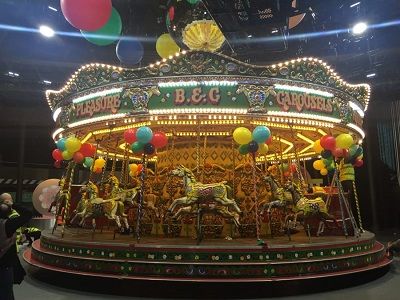
Many people believe a merry-go-round is a small children’s ride, such as the Toy Town Merry-Go-Round, while a carousel is a grand, decorated attraction like our Traditional Victorian Carousel. In practice the names are interchangeable. Merriam-Webster lists carousel and merry-go-round as synonyms, so there is no difference in meaning between the two.
Every carousel is a merry-go-round, and every fairground merry-go-round can be called a carousel. Some people also use “gallopers” for traditional rides where the horses rise and fall as the platform turns.
Why Do Some Carousels Turn Clockwise and Others Anticlockwise?
Another common belief is that the direction of travel decides the name. It doesn’t. The direction comes from regional tradition:
- UK carousels usually turn clockwise.
- North American and mainland European carousels usually turn anticlockwise.
The clockwise UK tradition is often traced back to the ride’s early use in cavalry training. Riders mounted from the left so they could hold a sword in their right hand, and a clockwise platform kept them facing the targets. Some historians also link the difference to which side of the road people and carriages travelled on in each region. You can read more in our full history of the carousel or our guide to how a carousel works.
When Is a Merry-Go-Round Not a Carousel?
In parks and playgrounds you may find small spinning platforms that children push by hand. These are often called merry-go-rounds or roundabouts, but they are not carousels because:
- they are not mechanically operated
- they do not need a trained operator
- they are made for free play, not as fairground rides
So the simple rule is: all carousels are merry-go-rounds, but not all merry-go-rounds are carousels.

Which Carousel Should I Hire for My Event?
If you’re planning a wedding, fun day or Christmas market, a carousel is one of the most popular fairground rides you can book. Our carousels and merry-go-rounds for hire range from the Children’s Victorian Carousel for younger riders to full-size traditional rides for guests of all ages. Every ride comes with delivery, set-up and trained staff, and we cover events throughout the UK, from London and Birmingham to Manchester, Leeds and Glasgow.
Merry-Go-Round and Carousel FAQs
Is a carousel the same as a merry-go-round?
Yes. Dictionaries treat the two words as synonyms, and both describe a rotating platform with seats or horses for riders.
Which way does a carousel turn in the UK?
Carousels in the UK usually turn clockwise, while those in North America and mainland Europe usually turn anticlockwise.
Is a playground roundabout a carousel?
No. A hand-pushed playground roundabout is sometimes called a merry-go-round, but it has no motor or trained operator, so it is not a carousel.
Can I hire a carousel for an event?
Yes. We supply carousel hire for weddings, fun days, school fairs and Christmas events, with set-up and trained staff included.
Ready to book? Our team can help you choose the right carousel for your guests and space. Call our Birmingham team on 0121 293 1377 or our London team on 0203 302 4757, or use our contact page to check availability for your date.
Carousel and Merry-go-Round Are Often Used for the Same Attraction
In everyday conversation, "carousel" and "merry-go-round" are frequently used interchangeably for a rotating amusement ride carrying horses, animals, vehicles or other passenger figures. The terminology can vary with location, tradition and the particular attraction being described.
That means the name alone should not always be treated as evidence that two rides work differently. What Is the History of the Carousel? provides useful background on how the familiar rotating attraction developed.
The Appearance Can Influence Which Name People Choose
An ornate traditional attraction with painted horses, mirrors and decorative panels is particularly likely to be described as a carousel. "Merry-go-round" can be used more broadly in everyday speech, including for smaller children's attractions and other circular rides.
Traditional Victorian Carousel represents the highly decorative style commonly associated with the word carousel, while Children's Victorian Carousel shows how the same visual tradition can be adapted to a smaller attraction.
Horses Are Traditional, but They Do Not Define the Ride
Carousel horses have become one of the strongest visual symbols of the attraction, but rotating rides do not have to use horses. Passenger positions can be designed as other animals, vehicles or themed figures without necessarily changing the fundamental circular ride concept.
Children's Horse Carousel retains the familiar equestrian theme, whereas Carousel Train Ride demonstrates how differently a circular children's attraction can be presented.
The Words Do Not Tell You Exactly How the Ride Works
Calling something a carousel or merry-go-round does not provide a complete mechanical specification. Individual attractions can differ in their drive systems, passenger figures, movement and overall construction.
How Are Funfair Rides Powered? looks at the wider question of ride power, while Fairground Electrical Safety Regulations provides related information about electrical systems within fairground environments.
Fairground Terminology Often Develops Alongside Tradition
The overlap between carousel and merry-go-round is a useful reminder that fairground language is influenced by history as well as engineering. Attraction names can survive for generations even as machinery, decoration and event formats change.
What Is the History of the Funfair? provides the broader historical picture, while Funfair History FAQs explores further questions about the development and terminology of fairground entertainment.
Traditional Decoration Helps Keep the Carousel Identity Strong
Painted horses, decorative rounding boards, lights and ornamental details have helped create the visual identity people associate with traditional carousels. This artistic heritage can therefore influence the words people use for the attraction as much as its mechanical movement does.
What Is the History of Fairground Art? explores how decoration became an important part of fairground culture, while traditional & vintage fairground rides & attractions brings together other attractions with strong links to fairground heritage.
For Event Hire, Look at the Actual Ride Rather Than Its Label
If you are choosing an attraction for an event, the practical specification is more useful than debating whether it should technically be called a carousel or merry-go-round. Consider the particular ride, its passenger requirements, dimensions, appearance and suitability for the intended audience.
How to Choose the Right Funfair Rides & Games provides wider attraction-selection guidance. You can also browse carousels, explore children's fairground rides & attractions, continue through our Guides, or contact us about carousel and fairground ride hire.