What is the History of the Helter Skelter?
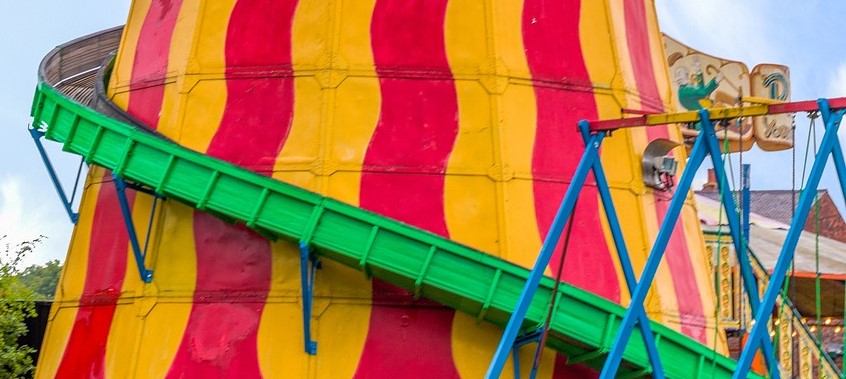
The iconic Helter Skelter slide holds a cherished spot in the annals of British amusement park history. This quintessential funfair ride, with its distinctive spiral slide wrapping around a high tower, has delighted generations. Let’s delve into the captivating history of the Helter Skelter, from its early days to its enduring presence in modern amusement parks.
Helter Skelter Etymology
The term ‘helter-skelter’ itself is derived from ‘kelter’ or ‘kilter’, meaning in good condition or order. Over time, it evolved into ‘helter-skelter’, connoting a sense of haste and disarray - a fitting description for the spiralling descent that characterises the funfair attraction.
Helter Skelter slides are much more popular in the UK than the USA, and across the Atlantic, the phrase would be more likely to remind people of the Beatles song named after the slide, or the horrific Charles Manson murders that Manson claimed were inspired by the song.
The First Helter Skelters
The first recorded appearance of a Helter Skelter was at Blackpool Pleasure Beach in 1906, a landmark moment in the history of slides. This initial Helter Skelter stood for thirty years until its removal in 1935.
The turn of the 20th century saw further innovation, with a notable Helter Skelter being constructed on Great Yarmouth's new Britannia Pier.
Dreamland in Margate, Kent, mirrored Blackpool Pleasure Beach in its early years. This theme park opening in 1920 with attractions that blended modern thrills with traditional funfair charm. Among its amusements was the Helter Skelter, standing alongside more contemporary rides like the House of Nonsense and the Tumble Bug.
Beyond the confines of amusement parks, Helter Skelters became a familiar sight on seafronts, piers, and other leisure spots across the UK (other than Blackpool itself!). Birnbeck Pier at Weston-super-Mare, North Somerset, is just one example of a location that featured this giant slide among its entertainment.
Despite a gradual decline in some areas, the Helter Skelter remains a beloved attraction where it continues to operate. The original Helter Skelter at Blackpool Pleasure Beach and its successor on Brighton Pier, which has been in place since 1977 after replacing a previous version destroyed in 1972, are testaments to the ride’s lasting popularity.
Today, Helter Skelters continue to captivate both young and old with their simple and thrilling descent. Contact us to book your slide today!
The Helter Skelter Makes the Structure Part of the Entertainment
Many fairground rides conceal much of their working structure beneath platforms, cars and decorative fronts. A Helter Skelter is different. Its tower is the attraction, with visitors climbing through the structure before descending around its exterior.
That makes the Helter Skelter an interesting companion to What Is the History of the Slide?, which explores the much broader development of sliding as entertainment.
Its Journey Starts Before the Descent
The experience is not limited to the moment somebody reaches the slide. Visitors first make their way upwards, so height is built gradually before the quick journey back towards ground level. The attraction therefore creates anticipation through movement around and through the structure itself.
This provides an interesting contrast with What Is the History of the Ferris Wheel?, where passengers gain height mechanically while remaining in a ride vehicle.
Gravity Does the Work on the Way Down
The Helter Skelter also stands apart from many mechanical fairground attractions because the descent does not require a powered ride vehicle. Once at the top, the rider's downward movement is fundamentally produced by gravity and controlled by the form of the slide.
For comparison, How Are Funfair Rides Powered? looks at the power requirements behind other forms of fairground equipment, from mechanical movement to electrical systems and supporting infrastructure.
A Spiral Creates a Lot of Slide Around a Compact Tower
Wrapping the slide around a central structure is one of the Helter Skelter's defining design features. Instead of extending a long straight slide away from a raised platform, the route circles the tower as it descends.
This gives the attraction a distinctive vertical form while also making the descent highly visible to people elsewhere at the event. giant slides provides a useful comparison with other ways of turning height into sliding entertainment.
Helter Skelters Became Part of the Traditional Fairground Skyline
The tall tower and external slide give the attraction a recognisable silhouette. Decorative panels, lighting and bold fairground styling can make the structure visually important even to visitors who are not using it.
What Is the History of Fairground Art? looks more closely at the decorative traditions that helped give fairgrounds their visual identity. Modern examples can also take noticeably different forms, including Helter Skelter (Illuminated), Helter Skelter (Square) and Helter Skelter (Lighthouse).
Its Identity Survived Without Becoming a Thrill Ride
Fairground development has produced increasingly complex mechanical attractions, but longevity does not depend solely on greater speed or more extreme movement. The Helter Skelter demonstrates how a straightforward activity can retain a place alongside technologically very different entertainment.
traditional & vintage fairground rides & attractions contains other attractions associated with traditional fairground character, while What Is the History of the Carousel? follows another enduring fairground design that remains recognisable despite changing construction and presentation.
Place the Helter Skelter in the Wider Fairground Story
The Helter Skelter connects several strands of amusement history: slides, fairground architecture, decorative art and traditional travelling entertainment. What Is the History of the Funfair? provides the broader setting, while What Is the History of Big Funfair Rides? offers a contrasting look at how scale developed elsewhere in the industry.
Continue through our Guides for more fairground histories and practical articles, browse fairground rides and all products, or contact us to discuss fairground attractions for an event.