What is the History of the Operation Game?

The Operation game, a beloved classic that has entertained generations of children and adults alike, has a fascinating history rooted in invention, creativity, happenstance, bad luck, and unfair business deals. John Spinello, an industrial design student, unknowingly shaped a significant part of pop culture in 1964 when he created what would become known as Operation.
Spinello was studying at the University of Illinois, and was tasked with creating an electric game for an assignment. His invention required players to navigate a metal wand through holes without touching the surrounding metal edges – a challenge that earned him an A grade. His invention could be considered an inversion of the Giant Buzz Wire challenge, and laid the foundation for the Operation game.
The original creation, known as Death Valley, was a departure from the familiar patient on the operating table seen in today's Operation game. Death Valley portrayed a character navigating the perils of a desert. With his water canteen rendered useless by a bullet hole, the character embarked on a desperate quest for water amidst a landscape filled with absurd and dangerous obstacles.
In this early version, players journeyed around the board, using a metal probe as their game piece. They had to carefully insert this probe into holes of differing sizes, a task that demanded precision and a steady hand.
Impressed by Spinello’s invention, a family friend, Sam Cottone, arranged a meeting with Marvin Glass, a renowned toy designer at Marvin Glass Associates (MGA). MGA was known for its innovative toys, including "Lite-Brite," "Mouse Trap," and "Rock 'Em Sock 'Em Robots." Glass offered Spinello $500 (equivalent to about $5,100 in 2023) for the rights to the design, along with a promise of a job upon graduation – a promise that, unfortunately, never materialised.
Marvin Glass sold Spinello’s concept to Milton Bradley, a prominent game company. Milton Bradley transformed it into "Operation", a game that struck a chord with its combination of skill, suspense, and a touch of medical intrigue.
The essence of the game was in its simplicity and the immediate feedback mechanism. If the player's probe touched the metal sides, it completed a circuit between two charged metal plates, triggering a loud bell – a feature that delighted and startled players.
In the 1980s, Milton Bradley became part of Hasbro, who continued to produce "Operation", ensuring its longevity. The game evolved from Spinello's prototype, which was a metal maze with drilled holes and a metal rod, into the well-known format of removing various ailments from a patient with a pair of tweezers.
Today, "Operation" has inspired numerous variants, including modern arcade game adaptations. At We Are Tricycle, we offer a giant operation game, which brings the same excitement and challenge on a larger scale, as well as some quirky alternatives to Operation such as Tap the App or Pluck the Duck.
The story of the Operation game is a testament to the enduring appeal of simple yet innovative gameplay, as well as a warning of the dangers of losing your intellectual property rights!
To explore our range of arcade games and classic funfair attractions, including our take on the legendary Operation game, look through all our products, or contact us for more information.
Operation Makes Careful Movement the Main Challenge
Many interactive games ask players to move quickly, throw accurately or apply physical force. Operation takes a different approach. Its central challenge is controlled movement, with the player attempting to complete a precise task without making an unwanted contact.
That places the concept within a wider family of skill games, where success depends on how the participant performs rather than simply watching an attraction operate.
The Possibility of a Mistake Creates the Tension
The task itself can appear straightforward until a penalty is attached to touching the wrong area. That changes the player's behaviour. Movements become slower and more deliberate, while the possibility of making a mistake creates much of the entertainment for people watching.
What Is the History of the Buzz Wire Game? offers a useful comparison because it also turns steady hand control and avoiding contact into the basis of a game.
Operation Represents a Different Kind of Physical Skill
Fairground and event games test many different abilities. A strength attraction rewards force, target games depend on aim and reaction equipment tests speed. Operation-style games instead concentrate on dexterity and coordination.
Compare this with What Is the History of the High Striker Test Your Strength Machine? or What Is the History of Batak? to see how different physical abilities can become the central mechanic of an interactive attraction.
Making the Game Bigger Changes the Social Experience
Increasing the physical scale of a familiar game can change how it works at an event. Controls and targets become easier for nearby spectators to see, so an individual attempt can become entertainment for the people waiting around the player.
giant Operation-style games develops this principle specifically for event use, while multiplayer games provides other options where interaction between participants is an important part of the activity.
A Familiar Concept Can Work as an Icebreaker
Games based on simple, recognisable objectives can be useful when an event needs entertainment that people can approach for a short attempt. Participants do not necessarily need to commit to a long session before another person can have a turn.
This makes precision games relevant alongside icebreaker games, team building and office entertainment, depending on the audience and format of the event.
Precision Games Contrast with Faster Electronic Challenges
Modern interactive entertainment increasingly includes electronic scoring, illuminated targets and rapid prompts. Operation-style play demonstrates that technology does not have to make a challenge faster. The appeal can instead come from forcing the player to slow down and concentrate.
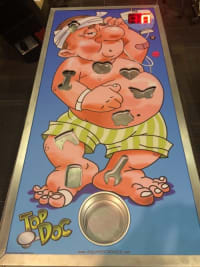
Top Doc provides a current event-game interpretation of the precision format, while Giant Buzz Wire offers another activity built around careful physical control.
Explore How Different Games Test Different Skills
The history of Operation connects naturally with the development of interactive games more broadly. What Is the History of Whack a Mole? follows a game centred on rapid responses, while What Is the History of Chess? moves in the opposite direction towards planning and strategic decisions.
Our Guides cover more histories and practical advice about games and attractions. You can also browse competitive games, electronic & digital games and all products, or contact us about interactive entertainment for an event.