How to Play Giant Jenga
Giant Jenga is a supersized take on the coffee table game that has been a stable of homes and pub tables across the world for decades. The rules of the game are simple, it’s just about how much skill and how steady your hands are. Giant Jenga is exactly what it says a scaled up big brother of the original one, and it comes in different sizes, some you may even need a step ladder on hand for!
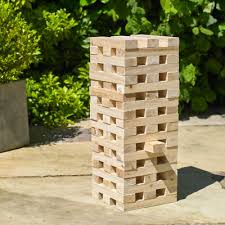
Giant Jenga is the ultimate garden party game - we think it’s more fun than croquet for sure - and it's perfect for weddings, barbeques and birthdays. There’s nothing quite like a leisurely game of it while people spectate and gasp at each move - you can cut the tension with a knife - and then crash, it all comes tumbling down! Here at We Are Tricycle we have a quick guide and a few tips on how to become the Giant Jenga champion at your next garden party!
- Set it up right - Simple enough, stack in blocks of three parallel to each other, the easy way to remember it is to line three blocks in a on the ground, the on top place three more rotated 90 degrees so they aren’t in line. And you're off ready to build your tower, build up repeating the process until you run out of blocks. This job is typically done by whoever lost the last game.
- Each player takes it in turns to remove one block from the tower and then places it on top without it toppling down - be careful which one you pick, and you can’t pick one from the top of course!
- Once you move a block you commit to that block so choose wisely! Players can gently tap blocks to see if they move - if they don’t then they’re difficult, but if they do then it’s your block! You'd best hope it’s loose everywhere!
- Tactics - Aside from looking and testing, the skill is having the steadiness of hand to remove the block when the going is tough. One way is to take one end of a block and gently shimmy it side to side until it loosens and quickly pull it away, then wait to see if the swaying of the tower gives in. Another great way of getting ahead in the game is just observing which side of the tower has the most bricks taken from it - that’s the side that’s likely to give in, but keep that to yourself! You want to win, don’t you?
- The killer move - Now only a special few have the ability to pull this off but if you can you can become unbeatable at the game. In the late stages of the game it’s not uncommon to have one central block supporting the whole tower, so it is impossible to move surely. Well as the saying goes nothing is impossible and with a swift, clean karate chop you can successfully take out that middle block! The crowd will go wild!
So now you’re ready to not only play the game but win it too, be prepared to stand back when the tower falls, but once it does you’ll be raring to go again!
Giant Jenga Is a Game of Changing Balance
Every turn changes the structure of the tower. Removing one block may have very little immediate effect, while another can alter how the weight is supported and make later moves considerably more difficult.
That changing balance is a major part of the appeal of Giant Jenga. Players have to assess the tower as it stands now rather than relying on exactly the same strategy in every game.
Choosing a Block Is Part of the Challenge
Players can examine the available blocks before deciding which one to move. A block that already moves relatively freely may be a more practical choice than one that appears to be carrying more of the structure, although the tower will become increasingly unpredictable as the game develops.
This creates a different type of skill from Giant Connect 4, where players are concentrating on patterns and anticipating an opponent's next move. Combining the two can therefore add variety to a garden games area.
The Tower Gets More Difficult as the Game Continues
Moving blocks from lower sections to the top gradually changes the proportions and stability of the tower. Later turns can therefore require more patience and careful judgement than the opening stages.
For events, this also means spectators can become increasingly interested as a game progresses. Giant Jenga can work as both a participant activity and something other guests can follow while waiting for their own turn.
Use Giant Jenga for Informal Team Competition
The game can be played casually between individuals or adapted for groups taking alternate turns. At corporate and organised events, teams can rotate players so that several people contribute to the same game rather than leaving every decision to one participant.
team building and icebreaker games provide further activities for group programmes. How to Plan a Team Building Day also looks at how different activities can be combined into a structured event.
Combine Physical Judgement with Strategy Games
A giant games area does not need several versions of the same activity. Giant Jenga tests careful movement and judgement, while Giant Chess and Giant Draughts put greater emphasis on planning and board-game strategy.
skill games provides further ways to vary the abilities being tested, while multiplayer games can help when participation between friends, families or colleagues is an important part of the event.
Give the Tower a Suitable Playing Area
Giant Jenga needs more than enough room for the tower itself. Players need usable space around the game, and organisers should account for the possibility of the blocks falling when the tower collapses. The particular equipment and hire setup should determine the space and operating arrangements required.
How Much Space Do I Need for Giant Garden Games? provides related guidance on planning space for oversized games, while Event Planning and Logistics FAQs covers wider event-layout considerations.
Match the Games Selection to the People Attending
Giant games can work in many event environments, but suitability should be considered for the individual participants, equipment and venue. Providing several different activities also gives visitors alternatives based on their interests and requirements.
Disabled Accessibility and Inclusivity at Funfairs & Fairgrounds provides wider inclusive-planning guidance, while How to Choose the Right Funfair Rides & Games can help when building an entertainment selection around a particular audience.
Add Giant Jenga to a Larger Games Zone
Because it does not depend on electronic gameplay, Giant Jenga can be incorporated into outdoor games areas, company events, family entertainment and other programmes alongside no power needed games, competitive games and other traditional activities.
Explore all products for more entertainment choices, continue through our Guides for related event-planning advice, or contact us to discuss giant games for your event.