How does a Roller Coaster work?
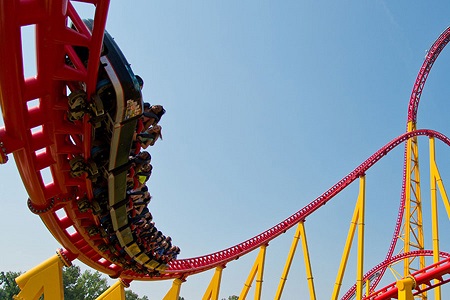
Ever wondered how roller coasters defy gravity and deliver those heart-pounding thrills without an engine? Let's unveil the scientific marvels and forces that bring these exhilarating funfair rides to life!
At the start of the roller coaster, a motorised chain pulls the carriage to the top of that thrilling first hill, making that iconic clanking noise as it goes. As the rollercoaster climbs higher and higher, the carriage stores up potential energy as it pulls against gravity.
Potential energy, also known as positional energy, represents the work the rollercoaster can do when it hurtles down the other side of the hill. And just like when you roll a ball down a slope, gravity takes over once the mechanised chain has finished its job.
As the rollercoaster reaches the crest of the hill, and passengers peer at the huge drop, the real excitement begins! With a constant acceleration of 9.8 meters per second squared, the potential energy converts into kinetic energy, the energy of motion, and this propels the carriage through the fairground ride.
Enter inertia, one of Sir Isaac Newton's laws of physics. This law ensures that an object in motion remains in motion until an equal but opposite force intervenes. Thanks to inertia, the kinetic energy built from the fall down the first hill keeps the carriage in motion.
During the thrilling loops, curves, and hills, the rollercoaster carriage encounters friction and air resistance that gradually sap the kinetic energy. Friction generates heat as the rollercoaster wheels interact with the rails, slowing it down, while air resistance blows riders' hair back as they zoom down the track.
The wild ride of the roller coaster also puts a variety of forces on the riders. As you experience loop-the-loops and sharp curves, special forces of acceleration push your body in different directions, creating that exhilarating "rush" that leaves you breathless and wanting more. That fleeting moment of weightlessness at the top of a loop-the-loop is a battle between gravity pulling you down and inertia pulling you towards the top.
If you need more information on roller coasters, check out our Roller Coaster FAQs, or visit our contact us page to see how to speak with us.
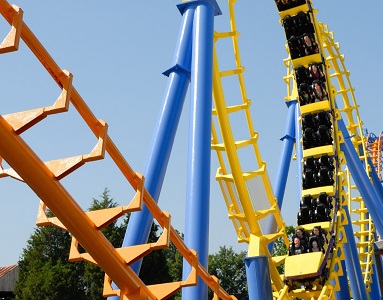
A Roller Coaster Is a Journey Through Changing Energy and Movement
Roller coasters are designed around a sequence of climbs, drops, curves and other track elements. Rather than every part of the course producing the same movement, the train's speed and direction change as it progresses, creating the different sensations passengers associate with a coaster.
What Are the Forces Experienced on a Roller Coaster? looks more closely at what those changes can mean for the people riding.
Getting the Train Moving Is Only the Beginning
Different roller coaster designs can use different systems to move a train through the course. On many traditional designs, gaining height early in the ride is important because the subsequent descent allows gravity to play a major role in the train's movement.
For the broader engineering context, How Are Funfair Rides Powered? explains how power is used by different types of fairground equipment.
Hills and Drops Turn Height into Speed
The relationship between height and speed is fundamental to many coaster layouts. As a train descends, gravitational potential energy can be converted into kinetic energy. As it climbs again, some of that kinetic energy is converted back into gravitational potential energy, while energy is also dissipated through factors such as friction and air resistance.
This is why the shape and sequence of the track matter so much. A roller coaster is designed as a complete course rather than as an arbitrary collection of hills.
Curves and Inversions Redirect the Train
Roller coaster tracks can also redirect the train horizontally, vertically or through more complex elements. Not every coaster contains inversions, but those that do are engineered so that the train follows the intended track geometry through the complete manoeuvre.
How Do Rollercoasters Go Upside-Down Without Falling Off? focuses specifically on inversions and explains why an upside-down coaster should not be imagined as a vehicle simply balancing on top of a rail.
Roller Coaster Trains Are Designed to Follow Their Track
The relationship between the wheels, train and track is central to coaster operation. The train is mechanically guided along its intended route rather than relying on gravity alone to keep ordinary wheels sitting on top of a track.
This principle allows designers to create substantially different layouts. What Are the Different Types of Roller Coaster? explores how coaster designs vary, while mini & children's roller coasters shows how the concept can also be adapted for smaller attractions.
Braking Is as Important as Acceleration
A roller coaster also needs controlled sections where the train can be slowed or stopped as required by the particular design. The systems involved are part of the engineered ride rather than the train simply losing speed naturally until it reaches the station.
A ride stopping unexpectedly does not automatically mean that something has mechanically failed. What Causes a Funfair Ride to Stop? explains some of the wider reasons an attraction may stop during operation.
Roller Coaster Engineering Extends Beyond the Track Layout
Understanding gravity, wheels and track geometry explains only part of a working roller coaster. Passenger seating and restraints, control systems, inspection, testing and maintenance all form part of the wider attraction.
How Funfair Rides Are Tested for Safety provides further information on testing, while Daily Safety Checks for Funfair Rides and Funfair Ride Periodic Maintenance look at other stages of the operational process.
Follow the Roller Coaster from Engineering to Rider Experience
Once the basic mechanics are understood, several related questions become easier to explore. What Is the Best Seat on a Roller Coaster? considers how position within the train can affect the experience, How to Cope with Motion Sickness at the Fairground covers individual responses to movement, and How to Stay Safe on Roller Coasters provides passenger guidance.
You can also read What Is the History of the Roller Coaster?, visit Rollercoaster FAQs, browse roller coasters, continue through our Guides, or contact us about roller coasters and other fairground attractions for an event.