How do rollercoasters go upside-down without falling off?
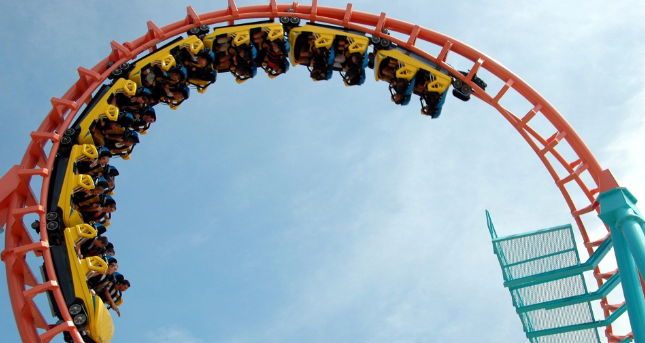
Roller coasters are known for their exhilarating twists, turns, and daring loops that defy gravity. It's a common wonder how these gravity-defying rides manage to keep passengers safely in their seats as they go upside down and perform gravity-defying manoeuvres. At We Are Tricycle, we bring the excitement of roller coasters and other thrilling rides to events across the UK, and we're here to unravel the mystery of how roller coasters navigate those thrilling inversions! You might also want to look into what forces act on roller coasters.
Physics and Engineering
The key to roller coasters going upside-down lies in the principles of physics and careful engineering. Roller coasters are meticulously designed with a combination of gravity, centripetal force, and momentum to ensure that riders remain securely in their seats as they experience these thrilling inversions.
Centripetal Force
When a roller coaster goes through an upside-down loop, it generates a centripetal force that acts as the "centre-seeking" force. This force pushes the riders toward the centre of the loop, keeping them safely in place against the seats and preventing them from falling out. The design of the track and the rollercoaster's speed as it completes the loop ensure that the centripetal force is strong enough to counteract the force of gravity.
Inertia:
Inertia, the property of an object to remain in its state of motion, also plays a crucial role in keeping riders secure during inversions. As the rollercoaster enters the loop, the riders' bodies want to keep moving in a straight line due to their inertia. However, the track's shape forces the coaster to change direction and follow the loop's circular path. In this way, the riders and the coaster maintain their motion and complete the loop without falling.
Safety Restraints:
Of course, modern roller coasters don't just rely on a few physical forces - they are equipped with secure safety restraints, such as over-the-shoulder harnesses and lap bars. These restraints are carefully designed to keep riders snugly in their seats during inversions and other high-speed manoeuvres.
Engineering Innovations:
Roller coaster designers and engineers continuously work to improve safety and ride experience. Computer simulations, advanced materials, and precise track designs allow for more daring inversions and exciting elements while maintaining the highest safety standards.
At We Are Tricycle, each roller coaster we offer is carefully inspected and maintained by our expert team to ensure a safe and thrilling experience for every rider. We can even help you design your own rollercoaster!
So, if you're ready for an adrenaline-pumping adventure, don't hesitate to contact us for funfair ride hire. Check out our other roller coaster FAQs for more information!
Inversions Are Designed as Part of the Complete Track
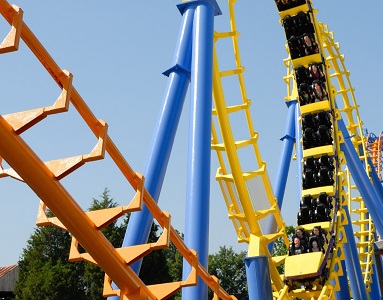
A roller coaster inversion is not simply a section of track that has been turned upside down. Its shape, the movement of the train and the transition into and out of the element all form part of the ride design.
How Does a Roller Coaster Work? provides useful background on the relationship between the train and track, while What Are the Different Types of Roller Coaster? looks at how substantially coaster designs can differ.
Roller Coaster Forces Change Through an Inversion
Passengers can experience changing forces as a train climbs, turns, drops and passes through an inversion. Looking at these forces provides much more useful context than thinking of an upside-down passenger as a stationary object being held above the ground.
What Are the Forces Experienced on a Roller Coaster? explores the physics and passenger sensations involved at different points around a coaster course.
The Train Is Mechanically Retained on the Track
The roller coaster train is designed to remain engaged with its track throughout the intended route. This is fundamentally different from imagining an ordinary wheeled vehicle simply balancing on top of a rail when it turns upside down.
The exact arrangement depends on the coaster design, which is another reason individual ride engineering matters when explaining how these attractions operate.
Passenger Restraints Are Part of the Ride Design Too
Passengers must remain appropriately positioned within the ride vehicle throughout the complete ride cycle. The seating and restraint arrangement is therefore designed for the movements of the particular attraction rather than being an optional precaution added because a coaster happens to contain an inversion.
Visitors should always follow operator instructions and should never attempt to interfere with a restraint. How to Stay Safe on Roller Coasters provides further passenger guidance.
Not Every Roller Coaster Needs to Turn Riders Upside Down
Inversions are only one way of creating an exciting coaster experience. Other designs can use hills, drops, curves and changes of direction without turning passengers upside down at all.
This distinction is particularly relevant when comparing larger roller coasters with mini & children's roller coasters. Why Do Some Funfair Rides Have Height Restrictions? also explains why passenger requirements need to be considered for the individual attraction rather than for roller coasters as a single group.
Testing Matters as Much as the Inversion Design
The engineering principles that make an inversion possible sit within a much wider system of inspection, testing, checks and maintenance. An explanation of why the train follows an upside-down section of track should therefore not be mistaken for a complete explanation of roller coaster safety.
How Funfair Rides Are Tested for Safety provides that broader context, alongside Daily Safety Checks for Funfair Rides and Funfair Ride Periodic Maintenance.
Explore More Questions About Roller Coaster Movement
Inversions connect several different areas of roller coaster engineering. What Is the Best Seat on a Roller Coaster? considers how position within the train can affect the experience, while How to Cope with Motion Sickness at the Fairground covers individual responses to ride movement.
For more related reading, visit Rollercoaster FAQs or What Is the History of the Roller Coaster?. You can also continue through our Guides, browse all products, or contact us about fairground attractions for your event.